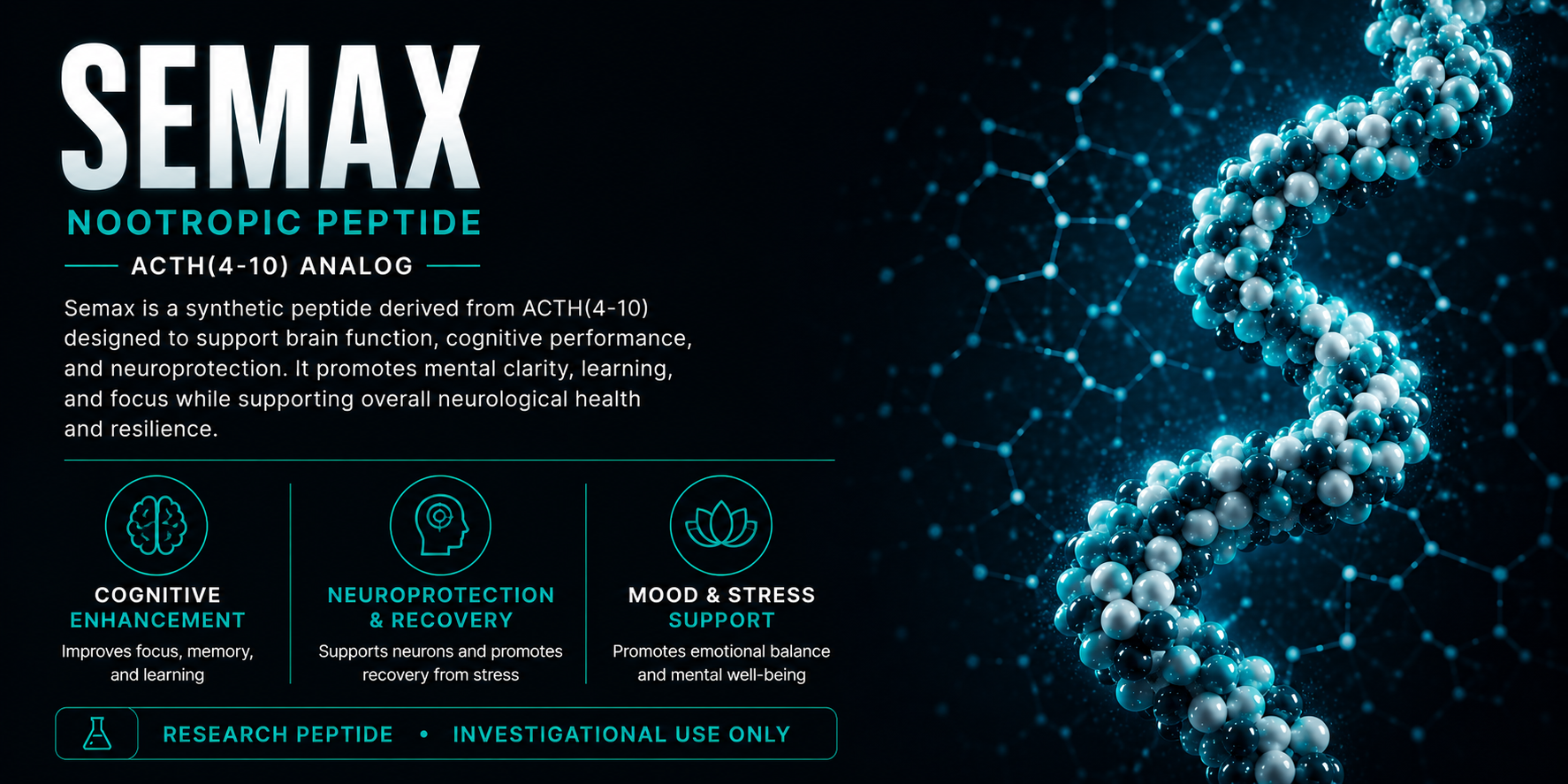
Semax
ACTH(4-10) Analogue
CognitiveOverview
Semax is a synthetic peptide derived from a fragment of adrenocorticotropic hormone (ACTH). Originally developed in Russia, it has been extensively studied for its potential effects on cognitive performance, neuroprotection, learning, memory, and neurological recovery.
Unlike traditional stimulants, Semax does not appear to exert its effects through direct stimulation of the central nervous system. Instead, research suggests it may influence neurotrophic factors, neurotransmitter systems, and brain signaling pathways involved in cognition and resilience. Due to these properties, Semax has become a popular subject of investigation within the fields of neuroscience, cognitive enhancement, and neuroprotection.
Mechanism of action
The precise mechanisms of Semax are still being investigated, but research suggests it may:
-Increase expression of Brain-Derived Neurotrophic Factor (BDNF).
-Support Nerve Growth Factor (NGF) activity.
-Influence dopamine and serotonin signaling.
-Promote neuronal adaptation and resilience.
-Support communication between neural networks.
-Modulate inflammatory pathways within the nervous system.
These combined effects are believed to contribute to the cognitive and neuroprotective properties observed in research settings.
Typical uses
Research involving Semax commonly focuses on:
-Cognitive performance.
-Learning and memory.
-Focus and concentration.
-Mental fatigue.
-Neuroprotection.
-Stroke and neurological recovery research.
-Stress resilience.
-Brain health and healthy aging.
Administration methods
Research protocols most commonly utilize:
-Intranasal administration (nasal spray).
-Less commonly, injectable preparations for laboratory research.
Intranasal delivery is frequently investigated due to its ability to provide direct access to central nervous system pathways.
Risks & side effects
Semax has generally demonstrated a favorable safety profile in research settings.
Reported side effects may include:
-Mild nasal irritation.
-Headache.
-Temporary dizziness.
-Fatigue.
-Increased alertness or stimulation.
-Changes in sleep patterns.
-Mild anxiety in sensitive individuals.
Responses may vary depending on the individual and research protocol.
Storage guidance
Unreconstituted
-Store refrigerated between 2°C and 8°C.
-Protect from heat, moisture, and direct sunlight.
-Keep vial sealed until use.
Reconstituted / Nasal Spray
-Store refrigerated between 2°C and 8°C.
-Avoid contamination of spray mechanisms.
-Discard according to supplier recommendations and protocol requirements.
-Maintain sterile handling during preparation.
Benefits
Research suggests Semax may support:
-Memory formation and recall.
-Focus and concentration.
-Mental clarity.
-Learning efficiency.
-Neuroprotection.
-Stress resilience.
-Cognitive performance under fatigue.
-Brain health and recovery research.
Typical Research Dosing
-Typical Starting Dose: 200 mcg to 600 mcg daily (applied as 1 to 2 intranasal sprays or drops, usually split between morning and early afternoon).
-Typical Maintenance Range: 300 mcg to 900 mcg daily.
-Typical Cycle Duration: 2 to 6 weeks, followed by a 2 to 4-week off-cycle "washout" phase.
Half-Life
Estimated plasma half-life: approximately 15–30 minutes.
Despite its short circulating half-life, downstream neurochemical and neurotrophic effects may persist significantly longer.
Reconstitution Notes
-Often prepared as a nasal spray solution for research purposes.
-Reconstitute using sterile diluent according to protocol requirements.
-Gently mix; avoid vigorous shaking.
-Store refrigerated after preparation.
-Maintain sterile handling throughout preparation and administration.
References
-Russian clinical and experimental research on Semax.
-Studies investigating BDNF expression and neuroprotection.
-Research examining cognitive performance and neurological recovery.
-Literature relating to ACTH-derived peptide analogues.
Disclaimer
Educational information only. Not medical advice. Consult a qualified clinician before starting, changing, or stopping any therapy.