Thymosin Alpha-1
TA1
OtherOverview
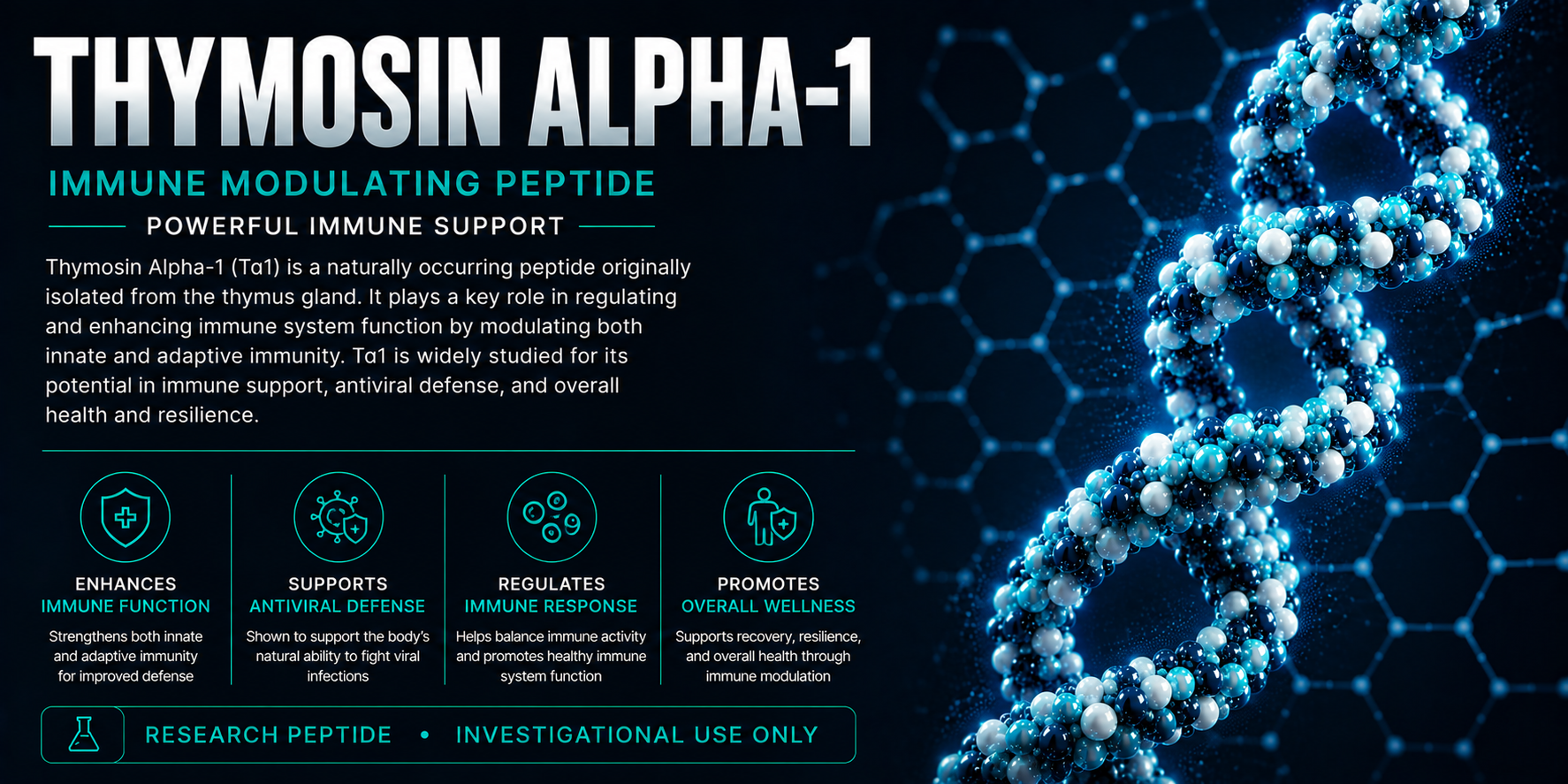
Thymosin Alpha-1 (TA1) is a naturally occurring peptide originally isolated from the thymus gland. It plays an important role in immune system regulation and has been extensively studied for its effects on T-cell function, immune signaling, and host defense mechanisms. Due to its involvement in immune modulation, TA1 has attracted interest in research relating to infection, inflammation, immune resilience, and healthy aging.
Mechanism of action
Thymosin Alpha-1 functions primarily as an immune-modulating peptide rather than a direct stimulant or suppressor.
Research suggests it may:
-Support maturation and activity of T-lymphocytes.
-Enhance communication between immune cells.
-Promote balanced cytokine signaling.
-Support natural killer (NK) cell activity.
-Improve immune recognition of pathogens and abnormal cells.
Unlike many immune stimulants, TA1 is often described as helping regulate immune responses rather than simply increasing them.
Typical uses
Research involving Thymosin Alpha-1 commonly focuses on:
-Immune system support.
-Viral infection research.
-Inflammation regulation.
-Recovery during periods of immune stress.
-Healthy aging and immune resilience.
-Autoimmune and immune-dysregulation studies.
-General wellness and host-defense mechanisms.
Administration methods
Research protocols most commonly utilize:
Subcutaneous injection.
Intramuscular injection.
Administration frequency varies depending on the specific research protocol being investigated.
Risks & side effects
Thymosin Alpha-1 has generally demonstrated a favorable safety profile in clinical and research settings.
Reported side effects may include:
-Injection-site irritation.
-Mild redness or discomfort.
-Headache.
-Fatigue.
-Nausea.
-Temporary flu-like symptoms.
Responses can vary between individuals and study populations.
Storage guidance
Unreconstituted
-Store refrigerated between 2°C and 8°C.
-Protect from heat, moisture, and direct sunlight.
-Keep vial sealed until use.
Reconstituted
-Store refrigerated between 2°C and 8°C.
-Avoid repeated warming and cooling cycles.
-Discard according to supplier guidance and research protocol requirements.
Benefits
Research suggests Thymosin Alpha-1 may support:
-Immune system regulation.
-T-cell function.
-Natural killer cell activity.
-Balanced inflammatory responses.
-Recovery during immune stress.
-General immune resilience.
-Healthy aging initiatives.
Typical Research Dosing
-Typical Starting Dose: 1.5 mg to 1.6 mg injected subcutaneously once every 3 days (or twice per week).
-Typical Maintenance Range: 1.5 mg to 1.6 mg twice weekly. (In contrast to weight-management peptides, the baseline dose and maintenance dose for TA-1 are generally identical; the compound does not require step-up titration).
-Typical Cycle Duration: 2 weeks to 12 weeks, followed by an equivalent or greater off-cycle period.
Half-Life
Estimated biological half-life: approximately 2–3 hours, although downstream immune effects may persist significantly longer than circulating peptide levels.
Reconstitution Notes
-Reconstitute using bacteriostatic water according to protocol requirements.
-Gently swirl; avoid vigorous shaking.
-Refrigerate after reconstitution.
-Maintain sterile handling practices throughout preparation and storage.
References
-Goldstein AL, et al. Thymosin Alpha-1 and immune modulation research.
-Clinical studies investigating Thymosin Alpha-1 in immune regulation and infectious disease.
-Published literature on thymic peptides and T-cell function.
Disclaimer
Educational information only. Not medical advice. Consult a qualified clinician before starting, changing, or stopping any therapy.